How AI Systems Discover Brands: Storytelling, Retrieval, and the New Rules of Visibility


TL;DR:

AI search is changing how brands get discovered.
Instead of lists of links, AI systems generate answers.

To show up, your brand needs to be:

→ Easy to find (retrievable across the web)

→ Easy to explain (clear, consistent narrative)

The brands that win are the ones AI can confidently describe.
If your story isn’t clear—or isn’t showing up in trusted places—you won’t be part of the answer.

AI search is changing how brands are discovered. Instead of presenting lists of links, systems like ChatGPT, Gemini, Claude, and Perplexity provide direct answers to user questions – often only recommending a handful of companies, when requested. This guide explains how modern AI systems retrieve and synthesize information, why storytelling and discoverability now work together, and how organizations can evaluate whether their brand is visible in AI-driven search.

Introduction

For most of the history of digital marketing, discoverability has primarily been a technical challenge. The better a company’s website ranked in search results, the easier it would be for potential customers to find them. To influence this traditional SEO ranking format, companies focused on technical on-site hygiene, strategic term selection, consistent content publishing, and authority building. If you applied effective strategy to those categories, with patience, you could expect to see enduring results after months of steady work.

AI-powered search systems are changing that model. Systems like ChatGPT, Gemini, Claude, and Perplexity generate direct answers to user questions instead of lists of links. 

We’re already seeing this shift in practice. Just the other month, a team member was  trying to find their dad a birthday gift. They asked ChatGPT for gag gift ideas, landed on one, and then asked for specific options to buy. The assistant surfaced products from sellers like Etsy, displayed the exact item in-app, and prompted them to purchase. They entered their information and checked out… all without visiting a website once.

This shift means visibility depends less on ranking mechanics (or the willingness to buy your way to the top) and more on whether AI systems can understand and confidently describe your brand to the searcher.

In this new environment, visibility emerges from the interaction of two forces: discoverability and storytelling.

Discoverability refers to the technical ability of AI systems to locate and retrieve information across the web.

Storytelling refers to the narrative signals that help AI systems understand what a company does, who it serves, and why it matters.

Brands that appear most consistently in AI-generated answers are those whose story and discoverability signals reinforce one another.

How AI Systems Generate Answers

Modern large language models rely on two primary knowledge mechanisms: static training knowledge and live retrieval systems.

The data a model is trained on becomes its baseline understanding of the world (language, industries, and organizations). However, all currently available models must stop training before being deployed to the public, and thus have a knowledge cutoff that cannot be updated until a new model is released.

To overcome this limitation and provide up-to-date information, most LLMs are connected to web-search tools. This isn’t as simple as running a Google search. The live-retrieval search process involves:

  • Breaking the user’s initial prompt into multiple (e.g., 3-5) fan-out search queries.
  • Reviewing the results and reading the sources from those searches.
  • Synthesizing the most relevant, updated information with the model’s static training knowledge into a final, comprehensive answer for the user.

This real-time search and synthesis process allows a new, highly credible article to influence AI-generated answers within hours or days – significantly faster than the month-long process of traditional SEO.

PR Now Shapes What AI Says About You

Web-retrieval in AI systems frequently prioritizes credible third-party sources when generating answers. These sources often include national business publications, industry trade outlets, analyst reports, reputable local media, and structured knowledge platforms such as Wikipedia.

This dynamic significantly expands the role of public relations in GEO.

Historically, earned media primarily shaped how people perceived a brand. In the context of AI search, it also shapes how AI systems understand and describe that brand.

Articles, rankings, and industry coverage can therefore become direct inputs into the information AI assistants use to generate answers. If it’s written about you, AI can use it to define you.

So How Does This Actually Work?

Different AI assistants rely on different search infrastructures and citation patterns.

ChatGPT frequently relies on the Bing search index and often favors authoritative third-party sources it can cite directly.

Gemini draws heavily from Google’s ecosystem, including Google reviews, Google Business Profiles, and pages that already perform well in Google search.

Perplexity emphasizes citation transparency and frequently aggregates information from comparative articles, directories, and community forums.

Claude relies on the Brave search index and tends to reward fresh content and broad visibility across the open web.

Understanding these differences helps organizations diversify their discoverability strategies rather than relying on a single search platform.

Test Your Brand’s AI Discoverability

One of the most effective ways to evaluate AI discoverability is surprisingly simple: just start asking questions

We’ve developed a specificity-funnel search method that determines your brand’s visibility level to the AI system you’re searching on, moving from general category questions to more specific needs, preferences, constraints, and differentiators. If your brand doesn’t appear in any of those prompts, you end by naming the brand directly.

Think of this as walking the same path your buyer would, just through an AI interface. For example:

1. Persona level
Start with who the buyer is.
“I’m a [persona]. Are there tools built for someone like me?”

2. Category level
Move into the broader solution space.
“What kinds of tools exist for [category/problem area]?”

3. Use-case level
Narrow toward the job they want done.
“What about tools for [specific use case]?”

4. Outcome level
Refine toward the result they actually want.
“Are there options that help me [specific outcome]?”

5. Primary differentiator
Test the main thing that sets your product apart.
“Is there anything that specifically [main differentiator]?”

6. Niche differentiator
Push into a more specific or distinctive capability.
“What about something that also [more niche differentiator]?”

7. Core offering / exact value
Describe the product as precisely as possible in plain buyer language.
“Is there a tool that [exact description of core offering or value]?”

8. Brand check
If your brand still has not appeared, name it directly.
“What about [brand name]?”

These prompts simulate the customer discovery journey.

The goal isn’t just to see if your brand appears, but how the category is populated. overall. This helps you understand when your brand shows up, which competitors or adjacent brands show up instead, and how strongly the model associates each brand with the category, use case, and differentiators.

Questions to examine include:

  • How long did it take for your brand to appear?
  • What sources did the AI cite?
  • Did phrasing the question differently change the outcome?
  • Were competitors recommended instead?

These signals make it easier to determine where AI systems are finding their information, and where gaps in your brand’s discoverability may exist.

Why Narrative Amplification Matters: One Story, Many Signals

Once you’ve discovered how well your brand is currently performing in AI search, the next step is knowing how to improve it. It’s easy to assume visibility comes from producing large volumes of content for both SEO and AI search. In reality, the strongest signals often come from a smaller number of clear, well-constructed narratives that appear consistently across credible sources.

But amplification only works if the underlying story is clear: what the brand does, who it serves, what makes it different, and how it should be understood within its category. If those elements are vague or inconsistent across content, AI systems are more likely to form a weak or fragmented picture of the brand.

This means the impact of a strong piece of content can extend far beyond its original publication.

When a company has a clear narrative, that story can be amplified across owned media, earned media, industry commentary, directories, and research reports. Each additional reference strengthens the same core understanding of the brand across the web.

Over time, this creates a broader network of discoverable signals. When AI systems encounter the same narrative across multiple credible domains, they are more likely to retrieve that company and incorporate it into their generated explanations.

This doesn’t  mean repeating identical content everywhere, however. It means extending the same core story across multiple formats, contexts, and channels so both people and machines can understand it more clearly.

This is why the intersection of content marketing, public relations, and GEO is becoming increasingly important. 

  • Content establishes the narrative.
  • Public relations expands it across trusted third-party domains.
  • GEO ensures the information is structured in ways that machines can retrieve and interpret.

When these disciplines operate together, a single well-constructed story can generate many discoverable signals across the web. For AI systems tasked with explaining a category, those signals often shape the answer itself.

Things Haven’t Totally Changed: Your Brand Presentation Still Matters

While AI-powered search introduces new dynamics, many of the core signals that influence discoverability remain consistent with traditional search optimization. 

For decades, search engines have aimed to surface the most relevant, credible, and useful sources for a given query. 

Traditional SEO relied on signals such as topical relevance, domain authority, link relationships, structured content, and user engagement to determine which pages should appear in search results.

 AI search systems still draw on many of these same signals, but instead of ranking pages in a list of links, they interpret relevant content and synthesize it into explanations. 

As a result, organizations with strong SEO foundations still have an advantage when AI systems retrieve and incorporate documents into their answers.

Authority Signals

Search engines have long relied on links and citations as indicators of credibility, and the same principle influences AI retrieval systems.

Content from well-known publications, reputable industry outlets, and high-authority domains are more likely to be retrieved and cited when AI systems construct answers.

Topical Relevance

Traditional SEO evaluates how closely a page aligns with a particular query. AI systems rely heavily on this same topical relevance when retrieving documents.

Explanatory articles, comparison pages, guides, and FAQs tend to perform well in both search results and AI retrieval.

Structured Content

Search engines and AI systems both rely on structured, well-organized content.

Clear headings, logical page hierarchy, descriptive metadata, and accessible text help machines interpret and summarize information accurately.

Consistent Brand Signals

Consistency across the web remains a foundational signal.

When a company’s name, description, and key facts appear consistently across directories, websites, and media coverage, search engines and AI systems can more confidently associate that information with the correct entity.

The Key Difference

Where traditional SEO focused on ranking pages, AI discoverability focuses on synthesizing information. Search engines present a list of links and let users choose which sources to explore. AI systems instead construct a narrative explanation based on the documents they retrieve.

This means the goal is no longer simply to appear in search results—it’s to be included in the answer. 

Just like in the gift example earlier, the user didn’t browse. They followed what was presented to them. 

That’s the environment your brand is competing in.

Complimentary AI Discoverability Audit

Start with a complimentary AI Discoverability Audit to see how visible your brand really is across AI search.

Your Audit Includes

AI Search Journey Test
We run real prompts in ChatGPT and other AI assistants to see if—and when—your brand appears.

GEO + SEO Visibility Snapshot
A quick look at your SEMrush signals, authority metrics, and how you compare with competitors.

AI Perception Analysis
What AI systems say about your company, what they miss, and which competitors they recommend instead.

Key Strategic Moves
A short set of recommendations outlining the highest-impact opportunities to improve AI discoverability.

Saying “No” to Grow: A case for revenue growth through focus.

By Todd Olsen, SVP of Marketing Practice

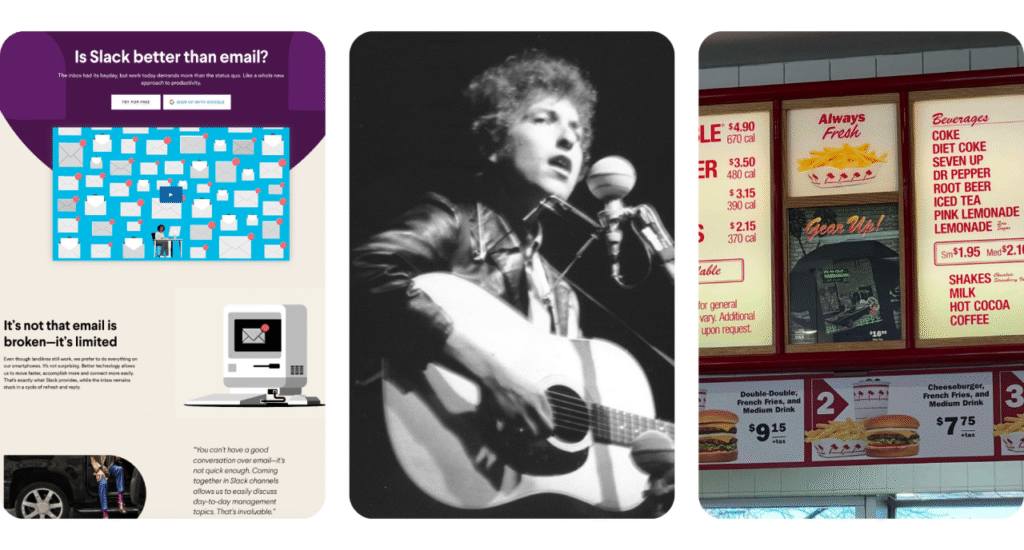
 What do Slack, Bob Dylan and In-N-Out have in common?

Traditional revenue growth is tough sledding right now – capital is more expensive than it has been in a decade, our inboxes are flooded with ZoomInfo spam, and our attention is fragmented unlike any other time. We can barely keep up with the news cycle, let alone evaluate a new product or service. 

This is why it’s time for a retrospective on how the best brands grow through disciplined, careful choices and extreme attention towards their best growth asset: customers. 

While it’s very easy to look to product expansion or paid performance marketing to unlock growth, we believe that the majority of brands can grow more profitably and healthily through mining their existing product lines for untapped value. Specifically: 

  • Making your product better by listening and identifying friction
  • Making it easy for your customers to share your product or service
  • Growing the right channels at the right time
  • Being legendary at a few things, versus pretty good at a lot of things

Here are 5 brands that are really good at saying no:

  • Slack started as an email killer, then built features that enhance team collaboration over time. Even their mission statement is this laser-focused statement: Making work life simpler, more pleasant and more productive. Who doesn’t want that?!
  • In-N-Out Burger: When will they launch a chicken sandwich? Never.
  • Apple: Fully realizes their product vision in a category before launching a new one. Desktops → Laptops → Music Players → Phones. Each one built on a foundation of trust and excellence. They launched the iPod 17 years after the first Mac in 1984!
  • Ridwell, who picks up hard-to-recycle waste from homes, has taken a one neighborhood at a time launch approach from their inception.
  • Bob Dylan: Didn’t plug his guitar into an electric amp with distortion until his 6th album.

3 areas to try reduction for growth: 

Pick one customer group and win with them. That means laser focus and understanding of exactly what they want, then delivering it in a legendary way. You’ll know you are ready to add a second customer group when the first one is actively referring you to their cohorts and you have achieved a strong market share. Put all the secondary and tertiary customers on hold until this happens.

Make it fit – and make it awesome – We often hear this referred to as “Product fit” but at Mother Bear we call this “Problem fit.” Pouring your product development efforts into one product that greatly exceeds expectations is far better than diluting them into multiple products that are so-so,

Pick a geography. A national or global distribution footprint and the marketing effort that comes with it can be incredibly dilutive while also having a minimal impact when spread so thin. Find a geography or a couple high impact channels or media partners to go deep with. Connected TV is a great way to go deep in a single market. Podcasts are a great way to go deep amongst a very tight interest audience. Find a regional playbook that wins, then expand from there.

Pick a channel. Brands like Oatly or Nutpods didn’t expand into grocery until establishing a strong customer base via Coffee shops (Oatly) and D2C + Amazon (Nutpods)

When is the right time to grow? Strong signals in each of the following channels can be indicators that you are ready for yes. 

Internal: Your org is ready to take it on. Do your employees seem out of breath or beleaguered? Are little things slipping through the cracks? Or, conversely, is your leadership team being actively pitched by your teams on what’s next? If it’s the latter, then it may be time to start expanding.

Customer: Your customers are pulling you in. Customer satisfaction (or net promoter scores) should be best in industry before expanding. Here’s a list of industry benchmarks. Are your DAU/WAU/MAU numbers exceeding your goals? Does a significant share of your new customer growth come from referrals? This  might mean you are ready to expand.

Channel: When you’re pulling versus pushing: Are channel distribution partners requesting meetings? Are their customers asking for your product? Then yes, you have created a strong foundation to grow into new channels.

At Mother Bear we start every engagement with a deep dive into your customer journey along with a clear-eyed evaluation of the marketplace and where you can win. Clients are often surprised by our candor and how often we say “No(t) a good idea.”. Which is why we also evaluate our fit and say no accordingly in our first conversations with a potential client. 

But when we say yes, it’s usually awesome.

Problem fit vs. product fit

By Todd Olsen, SVP of Marketing Practice

Apple, Rover and Xembly: three brands that are “problem-led”

As an integrated marketing agency closely following and serving the start-up market, we see a lot of buzz around the term Product Fit. Which usually, but not always, refers to technology-based brands that have pivoted their product multiple times to find the customer segment that will embrace their product. 

Problem fit is different – it’s a result of carefully considering and mapping your customer journey as they flow through a specific problem-solution path. Who they are, the moment they realize they have a problem, and what they do to research and solve it. 

We believe the most powerful tool for journey mapping is Design Sprint methodology, open source here. We use it all the time to find friction in a customer journey, then ideate how we might step in and solve it. Problem first, then solution. 

Here are some recreated problem/solution statements from brands you may know (two of which are our clients):  

Problem: People don’t want to be tracked by Facebook and a myriad of anonymous businesses scraping every bit of information from their mobile journey, but they feel forced into it to access the content they need.

Solution: Opt-in (versus out) cookie tracking and simple, easy-to-find privacy controls.

Problem: When you are away from home working, it’s painful to leave your pet alone all day, and you can’t keep hitting up your friends and family to walk them. 

Solution: The Rover app, which lets you book pet sitting and walking on demand through your phone – and the sitters come to your house.

Problem: My work week is so filled with meetings I don’t have the time to manage my own work week and personal priorities. 

Solution: An AI-based executive assistant that manages your calendar and takes and sends meeting notes so you can focus on being productive.

If your product isn’t gaining traction, you could have a brand foundation problem, a marketing problem, or an over-crowded competitive space. But if it’s a product problem, consider doubling down on the problem your customers are experiencing in their day-to-day. What meaningful friction can you identify and remove for them? Can your product address it with some slight adjustments? Great- do it! No? Consider going back as far as you need to in order to engineer for the problem better than anyone else is. 

Taking a beat to focus on the customer problem and rethinking how you might solve it is far more efficient than taking your organization through multiple product development and launch cycles. Mother Bear loves customer journey mapping to find a problem that’s worth building a product, or brand upon. Let us know if you would like a free consultation.

How to succeed at data storytelling

By Katie Curnutte, Mother Bear Co-Founder & Partner

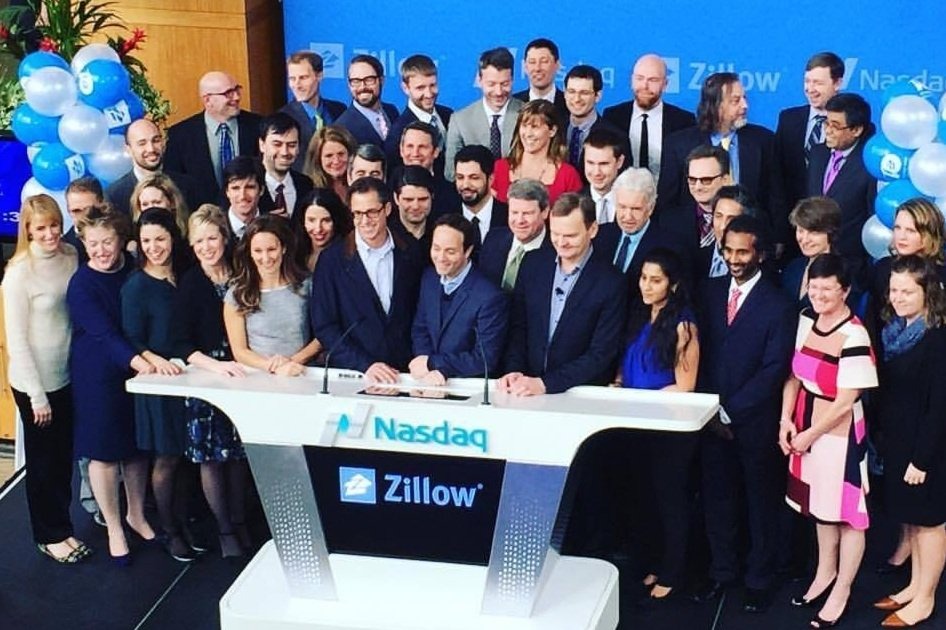
At Mother Bear, one of the most frequent requests we hear is to do what many of us did at Zillow: How can I turn my brand into a thought leadership powerhouse.

Lots of times, company leaders know they are generating data that could be interesting to consumers or other audiences. They want to leverage it, but they often don’t know where to start. Their internal team might be maxed out, or doesn’t have the expertise.  

Data storytelling is a great strategy from many angles. Establishing recognition of a company’s expertise in their field can accelerate its growth; shorten sales cycles; aid in government and investor relations; and even inform product development. From a macro perspective, companies today play an important role in helping policymakers, academics and investors understand industries and markets in ways they can’t from publicly collected data. Take our client Indeed, whose data Fed Chair Jerome Powell recently used in his Jackson Hole speech when talking about wage growth —  a big factor in the Fed’s interest rate decisions. 

Creating a data storytelling function can also be a lot of fun (I think so, at least!), and help smaller companies punch above their weight class. I learned a lot about how to do it right during my time at Zillow. Since then, Mother Bear has driven the creation of indices, like VTS’s Office Demand Index, which has become a go-to index for the commercial real estate industry. And we’ve created survey programs like Syndio’s that routinely measure workplace equity through lenses like caregivers; experiences at work, or how the pandemic prompted so many women to consider giving up their jobs. In their case, survey data gave us a way to get a small SaaS company on the radar of top-tier journalists. It also gave us fodder for webinars and owned channels. 

For leaders and marketers out there who have their eye on using their data to drive thought leadership, the most important thing is to make sure you have data —  or at least that you can generate a unique and provocative POV around existing, third-party data.

Beyond that, here are a few of my learnings:

1. Data storytelling can’t be done by a storyteller alone. Yes, telling stories with data is a real specialization. It’s not every writer or comms professional who can accurately turn numbers on a spreadsheet into a compelling story. In every truly successful data storytelling engagement I’ve been a part of, we’ve had a committed partner to pull and analyze data, bring us unique observations and collaborate as we turn the numbers into a story. 

At Zillow —  even at the very beginning of our data storytelling journey, when we had only 100 employees —  I had a data analysis counterpart. At least part of that person’s job was to be my partner in data storytelling, help conceive of original reports and, most importantly, ensure we were reporting on the data accurately. 

At bigger companies, like Indeed, there are whole departments dedicated to economic research. But most of our clients are in the “early Zillow” bucket. They’re smaller, without huge budgets. So how can you  ensure the proper resources? 

Often, companies will mandate that part of an existing data analyst’s position be dedicated to data storytelling (how much time will depend on the plan). In this case, it’s important for everyone from the CEO to that analyst’s immediate supervisor to understand this, and share an ongoing commitment to data storytelling. 

Sometimes we also work with outside economists who are consultants. Issi Romem, former Trulia chief economist, and his company MetroSight are one of our favorite collaborators. Issi and team —  or a similar type of firm —  can fill a critical role when there is nobody in-house to analyze and report on the data. They collaborate with the storytellers (like the Mother Bear team) to figure out what will be newsworthy, understandable and impactful, and consult along the way as we create materials to communicate the data.

2. You need data that can tell an interesting story. You don’t always need your own unique data for storytelling, but it’s often preferred. Surveys can work, but the real thought leadership / magic happens when you can create your own report that uses data and insights no one else has — reporters are more likely to want to interview you for commentary on your data (because no one else can speak to it) and they’ll come back to you for update numbers later on. The tricky part is that analyzing your own data or creating an index takes time, but doing the leg work and doing it right can create a news engine that keeps on giving. The inputs of unique data reports aren’t always internal —  sometimes a company can do analysis of third-party data. Some of the most interesting and successful reports I worked on at Zillow were analyses of publicly available data, but we had the spokespeople and expertise to create an interesting POV.

3. Leadership needs to be involved —  especially for smaller companies. Leaders of fast-growing companies are busy. We get that. But any thought leadership program —  data-centric or not —  needs the thoughts of a company’s C-suite. This is often the way your brand is introduced to reporters and consumers, so you want to ensure your leaders are aware, bought in and reinforcing the story. 

Leaders are also important for informing the story. They often have the best grasp of the big picture. They see what’s happening in their industry and they are talking to other leaders. More often than not, they are the spokesperson —  the face of their company and the data it is producing. 

I’ve seen lots of ways CEOs, COOs and others are effectively involved in a data storytelling program. Some CEOs will send a text or a voice memo when they have an idea. Some love to be in weekly meetings. Some prefer a quarterly brainstorm. 

All of that is totally fine, as long as the commitment is there and they can remain on the lookout for trends and ideas. 

For a leader whose time is simply too limited, it’s important that whoever is overseeing thought leadership and data storytelling be close to the fire. To be a proxy for leadership, this person needs to be attending investor meetings (even if they don’t speak), leadership meetings and to have a close relationship with the leadership team. 

4. Be patient. At Mother Bear, we always say, “PR is a garden. You can’t go from planting seeds to harvesting fruit overnight.” 

Same for data storytelling (which is not JUST for PR, but I’ll save that for a future piece). It takes time to understand the data at your disposal, establish a working relationship between the analysts and storytellers, and experiment to figure out what works. You might think something is interesting, only to find out it falls flat when presented to journalists and to your audience via social media. 

Embarking on a data storytelling program isn’t for you if you need results overnight —  say, you need to grow traffic ahead of a fundraise. But if you’re looking to create a credible and long-lasting brand, and you’re ready to commit the resources, data storytelling is a great way to leverage your expertise.

Mother Bear Brand Development Sprint: Unveiling the Essence of Taylor’s World

By Nancy Poznoff, Mother Bear CEO and Co-Founder

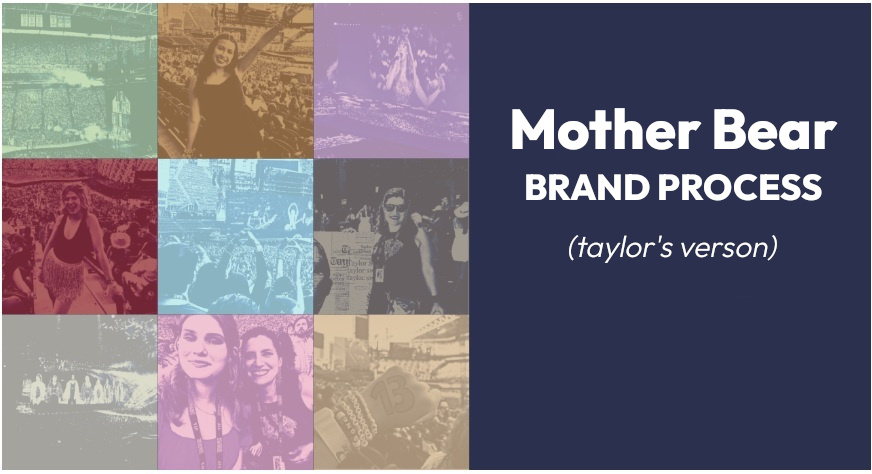
In the whirlwind of Taylor Swift’s world, from tour announcements to vault tracks, I found myself immersed in a journey I hadn’t expected. However, this unique experience as a mom to a Taylor Swift-obsessed teenager became an invaluable lesson in brand immersion. As the co-CEO of Mother Bear, a consultancy specializing in brand development, this journey inspired us to create the Mother Bear Brand Development Sprint: Taylor’s Version.

At Mother Bear, our mission is to help brands discover their voice and share it authentically with the world. Our team of creative marketers has developed a process that caters to companies of any size or stage. It all begins with a deep dive into understanding the customer, not just the product or the company. Through a series of exercises in our Brand Development Sprint, we unearth the DNA of a brand by delving into the customer’s needs, desires, and pain points.

To kick off the process, we ask crucial questions such as:

  • What three words describe your brand personality?
  • Where does your brand currently excel in delivering its promise, and where does it fall short?
  • Who are your main target audiences, and what specific problems can your business solve for them?
  • What drives progress and innovation within your industry?

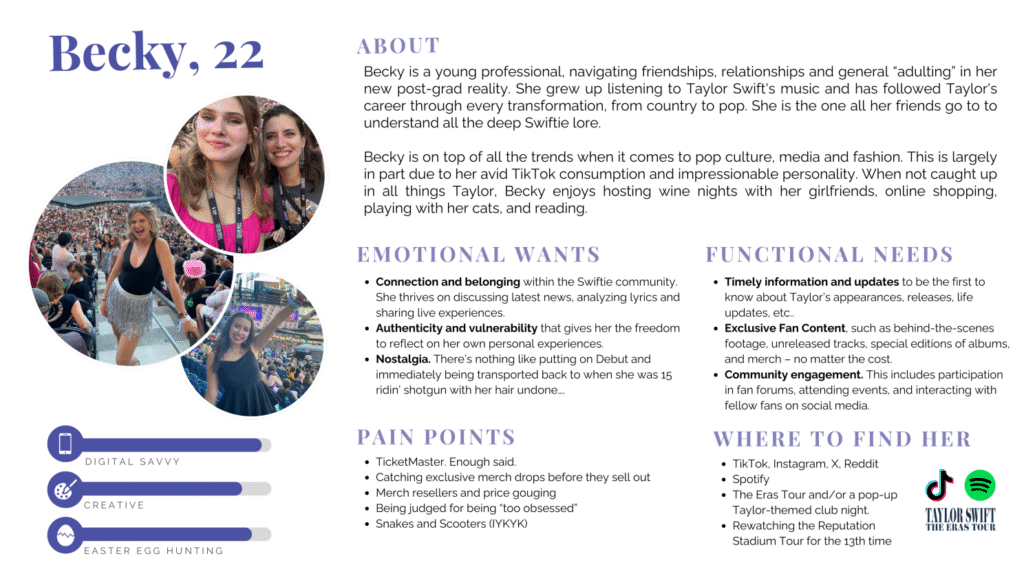
Using Taylor Swift as an example, we explore beyond demographics to truly understand her target customer—likely a 13-34 year old white girl or woman, middle to high-income, well-educated, etc. But the real challenge is uncovering who this customer is at a deeper level. What motivates them? What scares them? What do they need to do, and what do they want to feel? From this exploration, we create personas that capture the universal truths binding many customers together while leaving room for individual nuances.

For Taylor Swift’s bullseye target, let’s create a persona, called “Becky,” using Mother Bear’s standard template.

Understanding your customer is the foundation for building a genuine connection with your audience. With this groundwork laid, we move on to the next step in the Mother Bear Brand Development Sprint: The Brand Framework.

B2Boring: Stop thinking about your customer as a business and start thinking about them as a human.

By Todd Olsen, SVP of Marketing Practice

Certain flowers are uniquely designed to attract a specific hummingbird who, in turn, helps pollinate more flowers. Marketing is a lot like that.

We love working with companies to solve the magic puzzle of connecting the right customer to the right problem to the right brand. 

If there’s one pitfall we see a lot, it’s when clients think in terms of the aggregate instead of the individual when creating their marketing programs. The typical muscle memory is to lead with TAMs and transactions without first thinking about the brand relationship you are establishing with the human on the other side. Set aside the economic goals for a moment and think about what they are going through in their journey – both functionally and emotionally.

“Aggregate thinking” can lead to all kinds of bad habits when it comes to marketing. Some of these bad habits include, but are not limited to:

Bad Habit #1: Writing to a title. The word COO is useful in many ways. They have common responsibilities and share some of the same operator-DNA. But we can guarantee you, every one of them is different. And not a single one of them has the time to spend with boring copy, designs, or decks.

Bad Habit #2: Forgetting that your customer also has to sell to someone. And you have to help them. Even a COO has to socialize your SaaS platform before making a commitment. If they don’t bring everyone along, it won’t get adopted. 

Bad Habit #3: Forgetting about the immutable force that is inertia. Your product is unique and helpful. But your potential customer is bombarded with many great products all day long. The trick is to understand where the friction is, then intercept them at the right moment with a message that helps them consider a new, better pattern. 

Bad Habit #4: Mistaking a KPI with an insight. Google Analytics can tell you lots of interesting things about your customer flow, where things are breaking, and what your funnel looks like. However, it can’t tell you why your customer is hesitant to try your product, and what you might say to them to get them to reconsider. Talking to your customer is the only way to get at those important questions.

“If you are speaking to everyone, you’re speaking to no one.”

Here are three practices we use with just about every client project to help ensure we’re talking to the human, not the aggregate.

1. Create a solid brand framework. This is open source and has been effectively used by marketing and advertising firms for decades. My friend and colleague Lindsay Pederson wrote an excellent book on it that I highly recommend. I’ll give you the basics here: 

Who are you trying to talk to? 

What problem are they trying to solve? 

What benefit or promise can you deliver that solves the problem in a way that nobody else can? 

What three reasons can you offer so they believe it?

What emotional territory do they feel before and after you solve it for them? 

Note: There’s some art and science here so it helps to have a strategic sherpa like Mother Bear to guide the path. But any brand framework attempt is 100 times better than no brand framework. 

2. Conduct a customer journey mapping exercise. This is also open source. You can read about the Design Sprint here, in which the CJM is the first (most important) step. Basically you use post it notes and a giant white board to map the customer journey from their perspective – from problem initiation to research, through consideration, trial, repeat and referral. Where is their pain? How and where can you meet them with the aspirin? 

3. Tap into the power of surprise. It’s easy to forget about this one. Everyone likes to laugh, see something they didn’t expect, experience a legendary service moment, or feel like you really listened to them. Step back and consider this at every customer touch point.

At Mother Bear, we do this for a living and we love doing it. 

If you’re interested in learning more, we’d love to hear from you: Todd@motherbear.agency