
Mother Bear Brand Development Sprint: Unveiling the Essence of Taylor’s World
By Nancy Poznoff, Mother Bear CEO and Co-Founder
When you parent a Taylor Swift fan, you learn the calendar fast. There are tour dates, vault tracks, album countdowns and midnight releases, and every one of them matters to someone in your house. As the mom of a Swiftie teenager, I ended up inside one of the most closely watched fan communities in the world. It became one of the best lessons in brand immersion I’ve had. It’s also why we built the Mother Bear Brand Development Sprint: Taylor’s Version. It’s a structured way to build a customer persona that goes deeper than an age range and a zip code.
For the record, Taylor Swift isn’t a Mother Bear client. We use her world as a teaching case because almost everyone has a view of it. Her relationship with her audience shows what happens when a brand truly knows its customer.
Why customer understanding comes first
Our work with scaling brands starts in the same place every time. Before we touch messaging, visual identity or a campaign, we want to know who the brand serves, what those people need and where the brand keeps its promises or falls short. The product and the company matter, but the customer tells us which parts of the story will land.
The Brand Development Sprint is a series of working sessions that uncover a brand’s DNA through its customers’ needs, desires and pain points. It works for companies of any size or stage. Still, it earns its keep with scaling brands, because a fuzzy value proposition gets more expensive with every new hire, new market and new channel.
The four questions that open every sprint
To kick off the process, we ask four questions:
- What three words describe your brand personality?
- Where does your brand currently excel in delivering its promise, and where does it fall short?
- Who are your main target audiences, and what specific problems can your business solve for them?
- What drives progress and innovation within your industry?
The questions look simple, but the answers rarely are. Leadership teams often disagree on the three personality words, and that disagreement is useful. It shows us where the brand’s story has drifted from its strategy. The second question asks for candor about gaps. The last two move the conversation toward the customer and the category, where the real positioning decisions live.
Why a customer persona has to go beyond demographics
When we first ran this exercise, the easy read on Taylor Swift’s core customer was a teenage girl or young woman, fairly affluent and well educated. That’s the picture most people carry around. The data tells a broader story.
In a 2023 Morning Consult survey, 53% of U.S. adults called themselves Swift fans. Among avid fans, 52% were women and 48% were men. Millennials made up 45% of that group, and about half reported household income under $50,000. A year later, YouGov found the same near-even gender split among her fans.
If we had built her customer persona on assumptions, we would have missed half the audience. Scaling brands run into the same trap. A founder’s first customers become the mental model for every customer, long after the business has grown past them.
Demographics tell you who’s in the room. A strong customer persona tells you why they came. So we ask harder questions. What motivates them? What scares them? What do they need to do, and what do they want to feel? From there, we build personas that capture the universal truths binding many customers together, while leaving room for individual nuances.
Meet Becky, a sample customer persona
For Taylor Swift’s bullseye target, we created a persona called “Becky,” using Mother Bear’s standard template. Becky is the avid fan who clears her calendar on release day. An audience this broad calls for several personas, and Becky is where we start.
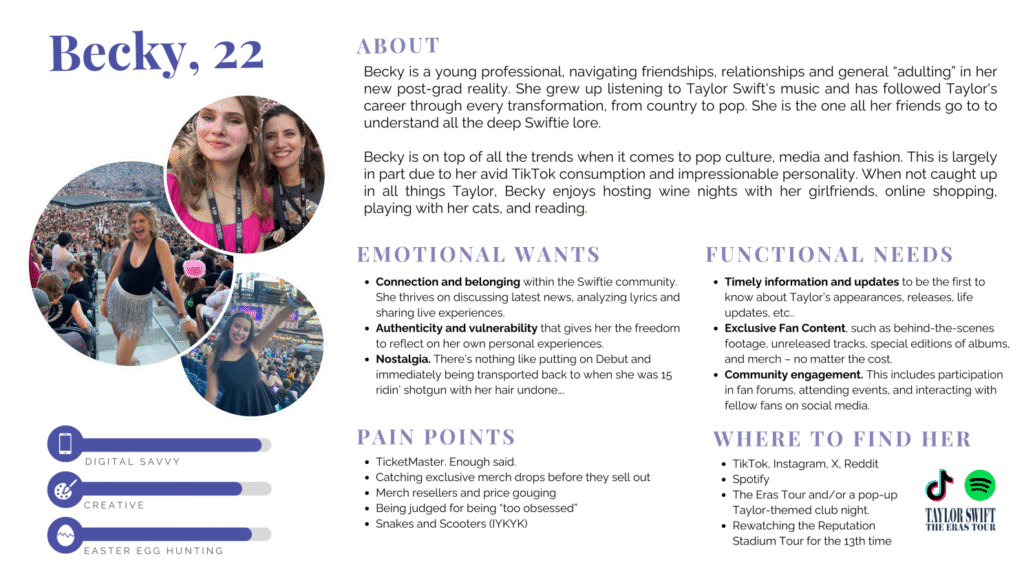
A persona like Becky earns its place when it moves past the demographic line and into motivations, fears, needs and feelings. That’s the part your marketing, product and sales teams can act on. It’s also the part that keeps a brand honest when a new idea sounds exciting but doesn’t serve the person it’s meant for.
What the Showgirl era teaches about knowing your customer
Swift’s recent moves read like a case study in acting on customer insight. When she re-recorded her early albums as “Taylor’s Version,” she was betting that her fans cared about ownership and loyalty as much as the songs. They did. Each re-recording debuted at No. 1, and in May 2025 she bought back the original masters of her first six albums.
The Eras Tour ran 149 shows between March 2023 and December 2024 and became the first tour to pass $2 billion. Then, in October 2025, The Life of a Showgirl moved just over 4 million album units in its first U.S. week, breaking the record Adele’s 25 had held for a decade. Release week included 27 physical variants and a theatrical release party in partnership with AMC. Each of those choices reflects a customer persona built around people who want to collect, gather and belong.
You don’t need a pop star’s budget to apply this. You need a clear picture of what your customer values beyond the product, and the discipline to design around it. For a B2B brand, that might be a buyer who wants to walk into the next board meeting with the best answer in the room. We made a related case in B2Boring: Stop thinking about your customer as a business. For a consumer brand, it might be a customer who wants to feel like an insider.
How to build a customer persona for your brand
Here is the approach we use in the sprint, and you can start it with your own team this week.
- Start with what you already know. Pull together sales notes, reviews, support tickets and CRM data. Nielsen Norman Group calls a persona built only on team knowledge a “proto persona”. It makes a fine first draft and a risky final one.
- Talk to real customers. For most teams, NN/g recommends qualitative research, often 5 to 30 interviews. Ask what problem they were solving, what almost stopped them from buying and how they describe you to a peer.
- Look for patterns. Sort what you hear into motivations, fears, needs and desired feelings. Let those shape the customer persona, rather than job title alone.
- Write the persona in your customer’s words. Give them a name, a face and quotes you actually heard. Specific language travels further inside a company than a slide of statistics.
- Put it to work. Test messaging, set priorities and brief creative against the customer persona. If interviews keep surfacing the same unmet need, our post on problem fit vs. product fit is a useful next read.
Then revisit the persona whenever your market shifts. Audiences grow and change, and a persona that no longer matches reality will quietly steer your team wrong.
From customer persona to Brand Framework
Understanding your customer is the foundation for building a genuine connection with your audience. With this groundwork laid, the sprint moves to its next step: the Brand Framework. That’s where customer insight becomes the positioning, personality and messaging your whole team can use with confidence.
If your brand has grown past the customer it was built for, that’s a good problem to have, and it’s the right moment to look again. Talk with Mother Bear about a Brand Development Sprint. We’ll guide you through it with tenacity and heart, and when the moment calls for it, we’ll help you roar.